Tuesday, August 3, 2010

Green Corps: Field Trip to CBG


After an absence of several weeks in Guatemala, this morning I met up with some of the Green Corps participants to lead a tour of the Chicago Botanic Garden. Like another planet for all of us, but in different ways. The group really responded to the peaceful feeling in the Japanese Garden. Here are a few of us in the tea hut at the edge of the Zen Garden. A nice respite given the extreme humidity (5 inches of rain last night) and temps near 90.

Guatemala 7: Scenic Mountain Beauty


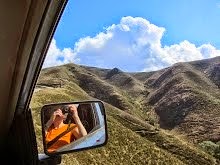
As our dear friend, Jeffrey (who writes the fabulous audio blog: HiFi Heroin) was departing for his return trip to parts South, I pointed out this postcard of Guatemala I had recently put on the frig. In a shocked tone, my husband commented that it was beautiful and asked me if that was where I had been. So in a proverbial wifely tone, I answered, "Of course, if you had been listening to me....."He then protested, "All you ever show in your blog is grey water or brown water. How would I know it was beautiful?" So, in deference to my better half, I show here some images of the Cuchumatanes Mountains in NW Guatemala where the villages AFOPADI works with are located.


Up in the clouds near Papal (10,000 ft): I think Wesley shot this from the back of the pick-up.

Looking through cornfield, outskirts Casaca (5,000 ft).

Saturday, July 31, 2010

Guatemala 6: Sustainability at AFOPADI


New garbage incinerator in T'umiche.


Above-ground cistern (most are in-ground) waiting to be connected at AFOPADI Resource House in Casaca. Note figs in foreground.


The composting toilet at Resource House during the day: no bugs and no need for the headlamp that is required night time gear. I imagine this worthy but challenging contraption for women in pants was designed by a man...

Guatemala 5: Water in Casaca


First of all, if you ask for agua, you will get a soda...there is no place too distant for a Coke or Pepsi truck to conquer. For the past three trips I have been drinking water from a clay Ecofiltro which is far more affordable and ecological than the previous alternative of plastic bottles of Aqua Pura.


Water is such a predominant issue. In the higher villages of T'umiche and Papal, women must spent 3 - 4 hours a day fetching water from down the mountain and then carting it up. This is part of why the cisterns are so vital. During the rainy season now (from May through October), the cisterns need to capture enough rain to last through the six-month dry season. Given the seasonal humidity, we needed about 3 - 4 days for our clothes to dry.


In Casaca, there is municipal water piped into people's homes.
In Antigua, where anything & everything lovely can be had, we were gifted with this rainbow.

Friday, July 30, 2010

Guatemala 4: View from Chicago


I'm back home and trying to navigate the terrain between third and first world. In the tourist city of Antigua, not only are there more signs in English, jade boutiques and ice-cream shops as numerous as the quaint cobblestones, but also I noticed this gym that promises the abs I don't have (the other wall displays the female version).

FYI: I added pictures to my three previous posts from Guatemala...

I was gentle with myself and waited until my second day home before listening to the news. In Guatemala, the papers are full of articles on the continuing violence that ravages the country from murders on city buses (gang & profit wars) to the relentless destruction of jungle habitat that surrounds the famous Mayan ruins in the northern Peten by cattle ranchers, loggers and drug dealers. Skewing the environmental balance is especially worrisome in the context of theories that the jungle Mayan culture disappeared about a 1000 years ago due to their destruction of habitat and inability to grow enough crops to sustain themselves.


These same issues plague us in Chicago and the US. Yesterday's radio contained stories on drug use in the military in Iraq, Afghanistan and among returning vets. Presumably, our strong American market (much among the upper middle-class, suburban, white populations with disposable incomes) drives the supply of drugs and the attendant problems. Gang violence is rampant in our city. Social class and racial identity divide people and pretty much determine quality of life: I read yesterday that our bottom 50% possess 1% of the wealth in the US. With continued growth of corporate farming that uses GMOs, chemical fertilizer and mechanical labor, our environment, health, employment and self-dignity continue to be at risk. Some people still voice the opinion that "sustainability" is something to convert to, as if it were religion, instead of science. Unless something changes, our future could have much in common with third-world countries like Guatemala.

I took the picture below outside the clinic of Common Hope just outside Antigua. [I have been sponsoring a child there to help him or her stay in school for the past decade: this time I was meeting my third child and his family. The previous girl got pregnant at 15 and left school and thus the program :( ] It is an interview with an indigenous woman of 39 who was infected with HIV by her partner before he abandoned her. It's a sad story, relatively new to Guatemala, but not to much of the rest of the world. What I find encouraging in this very Macho culture is that people are speaking openly about this new challenge. After knowledge, is action. We can choose to do nothing or try to walk together step by little step in a direction that honors our best qualities as human beings. Despite the grim conditions in Guatemala, for 25 years that country and its people have inspired me to such a degree that I feel lucky every day. And I believe I must share the privileges I inherited (clean water, electricity, education, health, social & racial advantages and relatively freedom as a women and a citizen) with those for whom they are inaccessible. This gives me great joy. The older I get, the clearer I know, that for better or for worse, this is part of my essential being. On my return flight when I changed planes in Cancun, I was viscerally reminded that I have always been far from the typical American...as if that is not already brought home to me every day in my life and business. Marketing is so ingrained in our global culture that sometimes I struggle to recall & connect with & pursue my inherent values.

Hopefully each real experience makes me braver in advocating and practicing those beliefs I hold dear.

What do you do to keep yourself true??? Please share & inspire.

Sunday, July 25, 2010

Back in the City


We are back in Quetzaltenango...I ate my first real meal in days and enjoyed eating.

Our time in the villages with the people of AFOPADI has been incredible. When I have more time, I will write details and show pictures. All the projects (silos, cisterns, organic agriculture) are going well. It´s hard to leave friends, especially those that lack the options I have to travel, but I know I´ll return.

Today is a beautiful day in the mountains: anthropromorphic clouds, but no rain...I am trying to enjoy the fresh air before returning to the heat of Chicago.

So much to process...so much global context.

Wednesday, July 21, 2010

At Home In Guatemala


We´ve been in the village of Casaca, where AFOPADI is located, since Saturday evening. We arrived with the rain that usually comes late in the afternoon and during the night. The sound of the rain combined with the loud croaking of the toads and the softer chirping of the frogs is perfect for sleeping. The morning is announced by roosters, dogs and burros. They say the the indigenas people here don´t need clocks because the burros neigh every hour.
I am writing from the internet cafe in the nearby town of San Ildefonso de Ixtahuacan located due West of Huehuetenango in Northwest Guatemala close to the border with Mexico. When I was last here there would be only one of two people beside me. But now the cafe is very crowded on weekends and after school with students during their homework. It´s a big change, almost as big as the growth of cell phones in the past few years. The countryside is catching up with the cities.
Up in the village of Papal (at 10,000 ft), change is a bit slower. We spent Monday there to celebrate the opening of 12 cisterns that AFOPADI had funded. Aside from the obvious benefits of bringing water to people who do not have any, this program also falls under the banner of "gender." Since the women are the ones who fetch water and wash everything (dishes, babies, clothes), having a cistern improves the quality of their lives substantially. The entire day was devoted to a fiesta, complete with traditional dancing: first the women, then the men, then the "extranjeros," five of us (two Belgians, two Americans and one German) making quite a motley crew. The lunch consisted of a giant corn stew with turkey, tortillas, coca-cola and Aguardiente (the local vodka from corn).
Yesterday AFOPADI held a workshop on vermiculture (worm compost) in Casaca. I only attended the first hour since it was my turn to get "la tourista." I was out of commission all yesterday but had wonderful attention. Being here is a very communal experience and that applies to being sick. While trying to lie still on the bed, everybody would poke their head through the shutters to see how I was feeling. That and the expert medical help I got from one of the health promotors helped me heal faster. Today I am well enough to eat rice and boiled carrots & plantains while washing them down with various medicinal teas (fennel & pericon) from the garden. And I had enough energy to ride in the pick-up down to this cafe.
Luckily Wesley was able to attend the workshop yesterday so I hope to add pictures later. As a student of Public Health with an interest in food/land/health, he is an ideal companion. We share interests, but his youth and the fact that this is his first visit outside the US means he has many interesting questions. (My first visit to Guatemala was in 1988 so I am a little jaded about some things here although my long relationship with this country I love enables me to have a little bit of perspective.) The night before they were preparing for the workshop, the AFOPADI people went into when kinds of manure would be useful for compost, how to split up the mixtures of materials that form the compost, what conditions the worms need, how fast they reproduce (every 8 days) etc.
This is my fifth visit to the projects (Health, Education and Agriculture) since 2005. The gains are incredible in face of the challenges: not enough land and very poor quality, little and unsafe water, little schooling or medical care, racism, the effects of the war, to name a few. I am constantly inspired by the people I meet here, how they continue to work towards a better life relentlessly despite great and frequent setbacks. These trips always make me consider the many things I take for granted. I not only feel grateful to have been born in a society that has so much, but I always feel lucky that I was born into my culture as a woman. Life is so hard here, but especially for the women. Just as when I taught Welfare mothers in the Humboldt Park neighborhood of Chicago, extreme poverty and discrimination often results in high alcohol use by the men who then take out their frustrations on the women with physical violence. What attracts me in AFOPADI is their capacity to address all the aspects of the problems and to deal with process. Even though many things are needed, ultimately it is the internal changes in self-esteem that result in the most sustainable changes.
Here "sustainable" is far more than a fashionable word or a business strategy...When I return, I hope to find people generous enough to donate a little to a place where small amounts make a huge difference. AFOPADI has asked me (in my capacity as the Earthways Project Director of Organic Agriculture) to focus on raising funds for cisterns. At $1000. per cistern, that is a small amount to change the life of a family. Even though the economic situation is not good in the US, we have relative wealth. And especially since our government has a long history of interfering in Guatemala and changing things for the worse, sharing what we have is what I suggest.