Friday, July 16, 2010

Checking-In from Guatemala


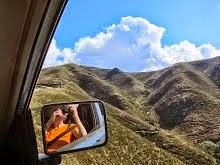
I am writing from the Guatemalan town of Quetzaltenango (actually just outside) where the AFOPADI office is located. We managed to bring down many donations, including 40 pounds of metal-working tools from our generous donor, Alan. My brain is already working fairly well in Spanish which means English is a bit of a challenge.

Here, I am finally seeing the country green during the rainy season: my last visit here during the summer was 1989 before I was affilated with Earthways & AFOPADI. the tall growing corn delights me endlessly. Since I am accompanied by Wesley, a graduate student in Public Health, it is interesting to process with a different perspective. His focus is on health, land and food and how they all interface.

I believe this is going to be an exciting visit and we will learn a lot. Today it´s wonderful to see old friends!


Sunday, July 11, 2010

Green Corps Native Plant Lab at CCGT Prairie


Since March, Thursdays have been the high point of my week. On those afternoons I have been volunteering and teaching design (and the many fundamental skills necessary to its practice) at Green Corps located at the Chicago Center for Green Technology (CCGT) and managed by WRD Environmental. Since I have been attending MELA meetings there for many years, the space is familiar. But this year I've had the opportunity to explore the prairie with many others' eyes & ears & noses & hearts on a weekly basis. I love teaching, especially with people who are open and focused on green-collar futures.


Above is one of my favorite plants, Eryngium yuccifolium (Rattlesnake Master) attracting insects. Be careful as it spreads its seed wantonly! But it was very useful for keeping smoking teenagers out of a library garden we did.

Below you can spot another insect on a native prairie plant: Eupatorium maculatum (Joe Pye Weed). I thought the pink looked surprisingly lovely against the pale grassy backdrop of a plant that is very invasive and will hopefully be eradicated soon: Phragmites australis (Common Reed). It colonizes waterways and is a big thug around the country.

At any rate, the prairie is a lab to observe & learn about nature in all its manifestations. So many people imagine gardens as sanctuaries, which they can be, but they are also microcosms and that includes the tranquil and the accompanying shadow sides of life.

Tuesday, July 6, 2010

Caldwell's Lily Pond 5: Next Walk & Talk 8/21/10


Wanted to leave you with this Monet-esque image Rebekah took of water lilies at Caldwell Pool.

...and a reminder to sign up for our next Walk & Talk on 8/21/10 at Wicker Park. There we will focus on Community Gardens, starting with the Wicker Park Garden Club.

We didn't have time at Lily Pool to pop across Fullerton to the Peggy Notebaert Nature Museum (below), but you can certainly explore on your own. Especially with our early hot & humid weather and the growing season running about three weeks ahead of normal, the prairie plants are already striking.

Caldwell's Lily Pool 4: Sustainability


The success of the recent renovation can be attributed to many factors.

First, it appears that the new design and installation was based on addressing the challenges of causes, not symptoms as in the 1960s renovation.

Second, a real community partnership resulted in thoughtful, long-term, real-world choices at all stages in the process.

Third, maintenance was addressed up front and planned on for the future.

Caldwell's Lily Pool 3: People


The Council Ring, derived from Native American culture and extensively implemented by one of Caldwell's mentor's, Jens Jensen, is always a people magnet. This trio arrived with crayons & paper and told me they usually visit once a week. By the way, admission is free although parking can be tricky...151 bus goes through Lincoln Park, Fullerton stop is half-block walk.


Even though the site is technically accessible, the level grade follows the east path and Council Ring. The interesting stone features (waterfall, fountain and pavilion) are located on the west path. Since one of our participants (the youngest) was in a wheelchair, we ended up lifting her over the steps. Consequently, I had a whole new perspective on the space. Another participant emailed me afterward that the slower pace enabled her to connect with the Lily Pool on a fuller and more intimate level.

I was continually charmed by turning corners in the paths and being surprised by people nestled in the landscape, claiming and creating personal space.

Caldwell's Lily Pool 2: Water Features


Warerfall is always a hit with kids. I was interested to learn that during the recent renovation at the start of the millennium (partners included the Lincoln Park Conservancy, the Chicago Park District, Wolff Clements and Associates, the Care of Trees and other private companies), many stones (that had been added during the renovation of the 1960s) were removed to retrieve negative space. As a designer, I am always harping on mass & void making a whole, especially in gardens which are often so crammed full that we lose the joys of form, color, rhythm, breeze, shadow and surprise.


The water fountain has always delighted me. Originally, in the 1930s, Caldwell designed it at two levels in order to better accommodate migrating birds. Below: you see it from the opposite bank: it is the rock feature jutting into the pool to the right.

Alfred Caldwell's Lily Pool, Lincoln Park


The second in my series of Walks & Talks http://www.jsiegeldesigns.com/class_lect_current.html
took place on 6/25/10, luckily one of the few days minus high heat, humidity & thunderstorms.
(Of course, everything now has been bone dry for the past week...) Except for my very generous helper, Amy Moses, the group was completely different than the Humboldt Park walkers. One of the perks is to get such differing perspectives...at Lily Pool, Janine Fron was especially helpful in providing historic resources and Rebekah Steers shot some of the photos you see here.

A number of participants told me that the place worked it's magic on them such that they were entranced and more interested in interacting with the space than the people: Bravo!


As usual: despite the location being right behind the crowded Lincoln Park Zoo and Fullerton Beach and Peggy Notebaert Nature Museum, once inside we were transported from urban chaos to engrossing & tranquil, geological and horticultural and wildlife embrace.